
Trump’s Third-Term Fantasy
A Dangerous Threat to Democracy
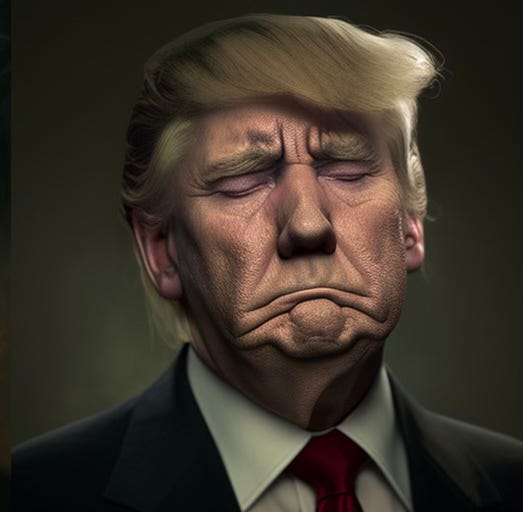
In a deeply unsettling development, former President Donald Trump has once again floated the possibility of seeking a third term in office—despite the clear constitutional prohibition against it. During a recent interview, Trump declared,
“There are methods”
to remain in power beyond the two-term limit, adding,
“I’m not joking.”
While Trump’s rhetoric is often dismissed as political posturing, this time his remarks carry a far more menacing tone, hinting at intentions to subvert constitutional constraints. The U.S. Constitution’s 22nd Amendment, ratified in 1951, explicitly limits presidents to two terms, yet Trump’s open defiance of this safeguard poses a clear and present dangerto America’s democratic norms.
✅ The 22nd Amendment: A Clear Limit on Presidential Power
The 22nd Amendment was introduced after Franklin D. Roosevelt won an unprecedented four consecutive terms, serving from 1933 to 1945. Fearing the consolidation of executive power, Congress passed the amendment to codify the two-term tradition.
It states:
“No person shall be elected to the office of the President more than twice.”
This was intended to prevent any individual from becoming too powerful—a principle that Trump now appears willing to challenge.
🚫 Trump’s Strategies: Undermining the Constitution
While it might seem impossible for Trump to circumvent the Constitution, his supporters have already floated fringe legal theories and loopholes to make it happen.
Some of the most alarming suggestions include:
Running as Vice President: Former Trump advisor Steve Bannon has publicly suggested that Trump could run as a vice-presidential candidate, pair with a loyalist figurehead, and assume the presidency once that person resigns. While this violates the spirit of the law, some legal experts argue it could technically be exploited through a constitutional gray area.
Declaring a “National Emergency” or Martial Law: During his previous term, Trump considered invoking emergency powers to delay the 2020 election. With the current political climate more polarized than ever, he could weaponize a manufactured crisis to justify a third-term push, claiming it’s necessary to “stabilize” the country.
Constitutional Amendment or Legal Challenge: Though highly unlikely, some Trump allies have hinted at the possibility of seeking a constitutional amendment or mounting a legal challenge to the 22nd Amendment itself. This would require two-thirds of Congress and three-fourths of states to approve—a near-impossible feat but a sign of how far Trump’s movement is willing to go.
⚠️ The Dictator Playbook: Eroding Democratic Norms
Trump’s flirtation with a third term mirrors the tactics of authoritarian leaders worldwide.
In Russia, Vladimir Putin bypassed term limits by becoming prime minister before returning as president. He later orchestrated a constitutional amendment allowing him to stay in power until 2036.
In China, Xi Jinping abolished presidential term limits entirely, paving the way for his lifelong rule.
In El Salvador, Nayib Bukele secured a second consecutive term by stacking the Supreme Court with loyalists, who ruled that the ban on reelection was “unconstitutional.”
By normalizing the idea of a third term, Trump is signaling his willingness to follow the same playbook—eroding the guardrails of democracy while exploiting legal loopholes.
🛑 The Danger of Normalizing Lawlessness
While Trump’s remarks might be dismissed as bluster, they are part of a larger pattern of undermining democratic institutions.
2016: Trump repeatedly suggested he might refuse to accept the election results if he lost.
2020: After losing to Joe Biden, he attempted to overturn the election through false claims of fraud, culminating in the January 6th insurrection.
2024: With a second presidential run underway, he is already signaling his intent to challenge the rule of law if reelected.
By casually discussing a third term, Trump is testing the waters—gauging whether his supporters, the Republican Party, and the courts will tolerate this blatant disregard for the Constitution.
⚖️ Constitutional Crisis: Can It Be Stopped?
Legal experts warn that while Trump cannot simply decree a third term, the erosion of legal norms could make it feasible.
Weaponizing the Courts: Trump has stacked the federal judiciary with loyalist judges, many of whom have shown willingness to overlook constitutional norms. A Supreme Court ruling favoring Trump’s interpretation of the 22nd Amendment could effectively rubber-stamp his third-term aspirations.
GOP Loyalty: With the Republican Party increasingly falling in line with Trump, there is little guarantee that they would resist an effort to extend his presidency.
Weak Checks and Balances: If Trump wins a second term, he could exploit the Department of Justice, the FBI, and other institutions to silence critics, intimidate opponents, and consolidate power.
The frightening reality is that America’s democratic guardrails are only as strong as the institutions and individualswho enforce them. With enough political will, even clear constitutional limits can be bypassed or ignored.
🌍 The Global Consequences: America’s Democracy at Risk
If Trump succeeds in weakening or bypassing the two-term limit, it will signal a major blow to global democracy.
The U.S. would lose credibility in promoting democratic norms abroad.
Authoritarian regimes would be emboldened, using Trump’s actions as justification for their own power grabs.
It could trigger further political instability at home, with both parties increasingly willing to defy constitutional norms.
A third-term presidency would effectively mark the end of America’s post-World War II democratic order, ushering in an era of permanent incumbency.
🚨 The Bottom Line: Democracy Is on the Line
Trump’s suggestion of a third term is not mere political theater—it is a trial balloon for authoritarian overreach. By floating the idea and observing the public’s response, he is normalizing the once-unthinkable: a U.S. president clinging to power indefinitely.
We must be clear:
The 22nd Amendment exists to prevent precisely this scenario.
Any attempt to evade or dismantle it is a direct attack on the Constitution.
Failing to confront this rhetoric now risks legitimizing it later.
As Benjamin Franklin famously warned:
“A Republic, if you can keep it.”
The fight to keep it has never been more urgent.